Our CRAQ colleagues, members of the “CHIME Fast Radio Burst” team, receive the 2022 Berkeley Prize
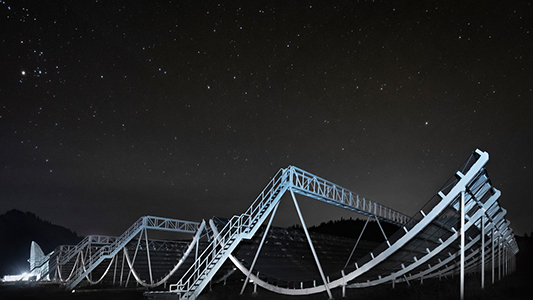
The Canadian Hydrogen Intensity Mapping Experiment fast radio burst (CHIME/FRB) team, which discovered more than 500 new fast radio bursts in the first year of the detector’s operations, receive the 2022 Lancelot M. Berkeley − New York Community Trust Prize for Meritorious Work in Astronomy. Bestowed annually since 2011 by the American Astronomical Society (AAS) and […]
A new professor joins the CRAQ
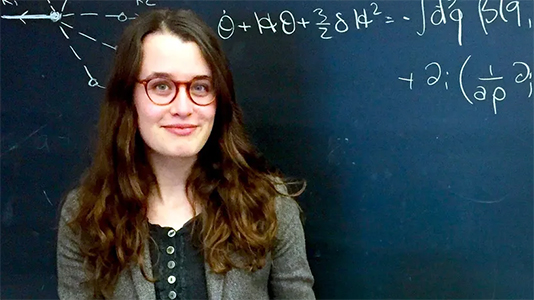
The Centre for Research in Astrophysics of Quebec (CRAQ) welcomes a new professor of astrophysics. Katelin Schutz joined the McGill University Astrophysics Group as Assistant Professor in August 2021. She holds a bachelor’s degree in physics from MIT (2014) and a doctorate from Berkeley University (2019). She received the Sakurai Dissertation Award from the American […]
Emilie Parent receives one of the SWAAC Graduate Student Award of Merit for 2021
Emilie Parent, a PhD Candidate in the Department of Physics at McGill University and member of the McGill Space Institute, has received one of the 2021 Graduate Student Award of Merit from the Senior Women Academic Administrators of Canada (SWAAC). Emilie’s research centres on observations of neutron stars: the stellar remnants left behind when massive stars […]
Ziggy Pleunis receives a PhD Prize from IAU

Ziggy Pleunis, who recently completed a doctoral thesis under the supervision of Professor Victoria Kaspi (McGill), was awarded a PhD Prize from the “High Energy Phenomena and Fundamental Physics” division of the International Astronomical Union (IAU) for the year 2020 Dr. Pleunis’ thesis, entitled “Fast radio burst detection and morphology with the CHIME telescope”, represents […]
Nathalie Ouellette wins a Prix du recteur 2021

Nathalie Ouellette, Coordinator of iREx and CRAQ member, is the winner of one of the “Prix du Recteur” of the Université de Montréal awards for 2021, in the category Initiative. This award recognises the imagination, dynamism and creativity of a member of the Université de Montréal community. “Nathalie Ouellette embodies passion, devotion and leadership,” said […]
CRAQ member Victoria Kaspi receives the 2021 Shaw Prize in Astronomy

The Shaw Prize in Astronomy 2021 is shared equally by Victoria M. Kaspi, Professor of Physics, Director of McGill Space Institute and member of the Center for Research in Astrophysics of Quebec (CRAQ), and Chryssa Kouveliotou, Professor and Chair, Department of Physics at George Washington University, for their contributions to our understanding of magnetars, a […]
A Solar Eclipse on the morning of June 10th 2021
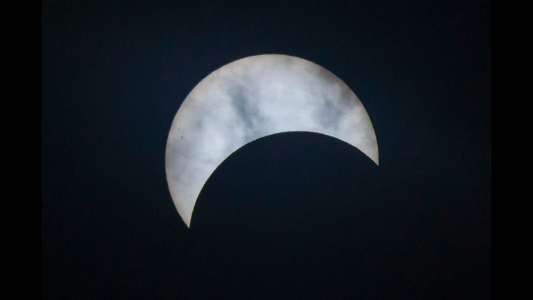
The Centre for Research in Astrophysics of Quebec (CRAQ), the Institute for Research on Exoplanets (iREx) and the Observatoire du Mont-Mégantic (OMM), invite you to admire the solar eclipse taking place at sunrise on the morning of June 10th 2021. A rare event! The Sun during the eclipse of August 21st 2017. Credit: Étienne Artigau.A […]
La petite école de l’espace
The Institute for Research on Exoplanets, in collaboration with the Observatoire du Mont-Mégantic and the Center for Research in Astrophysics of Quebec invites kids from 3 to 8 years old to “La petite école de l’espace” (in French). During these online events, astrophysicists Frédérique Baron and Marie-Eve Naud tell space-themed stories and answer your youngsters’ questions about astronomy, the […]
Astronomer in Your Classroom – 24h of Science
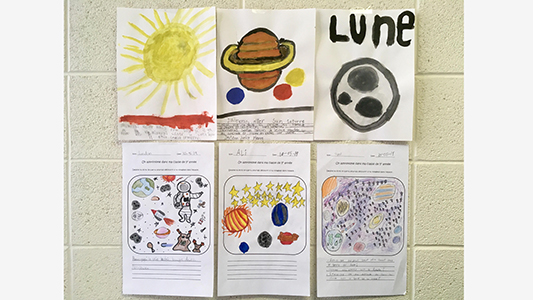
As part of the 24h of science, on May 7 and 8, 2021, the Institute for Research on Exoplanets, in collaboration with the Center for Research in Astrophysics of Quebec (CRAQ) and the Mont-Mégantic Observatory, proposed the “Astronomer in your virtual classroom” activity. This year, the theme for the 24h of Science was ‘Unusual Science‘. There […]
Professor Laurent Drissen is one of the first recipients of the new PRISME program from the FRQNT and the FRQSC
In January 2021, the Fonds de recherche du Québec – Nature et technologies (FRQNT) and the Fonds de recherche du Québec – Société et culture (FRQSC) launched a new interdisciplinary program called PRISME. This program invites research teams to make the sciences and the arts interact through a project carried out jointly by two researchers […]