Look up challenge

The CRAQ in collaboration with the Institute for Research on Exoplanets (iREx), the Observatoire du Mont-Mégantic (OMM), the Dunlap Institute at the University of Toronto and “Discover the Universe” proposed the challenge to lookup to the sky during the holiday season, between December 16, 2020 and January 6, 2021. Credit: Guillaume Poulain, guillaumepoulain.com The goal […]
The work of our McGill colleagues, members of the CHIME/FRB consortium, on the discovery of a rapid radio burst in our galaxy, is part of Nature’s top-10 discoveries of 2020
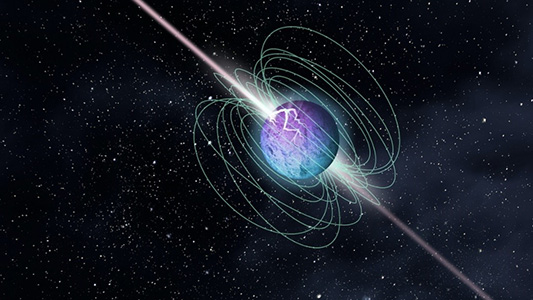
Their work is part of one of three articles published in Nature reporting the detection of a phenomenon called a fast radio burst (FRB) coming from a source in our Galaxy. Intriguingly, the FRB was accompanied by a burst of X-rays. The discovery was made and understood by piecing together observations from multiple space- and […]
The 2020 CAP Medal for Excellence in Teaching Undergraduate Physics is awarded to Kenneth Ragan

The Canadian Association of Physicists (CAP) is pleased to announce that the 2020 CAP Medal for Excellence in Teaching Undergraduate Physics is awarded to Kenneth Ragan, McGill University, for his overall accomplishments in teaching, and the promotion of quality teaching at his institution and within the CAP. He has taught many different courses spanning the […]
Detection of a short, intense radio burst in Milky Way could help resolve origins of mysterious phenomenon
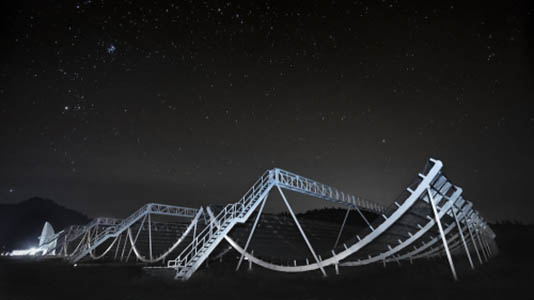
Close proximity of high energy pulse suggests magnetars may be at the origin of some fast radio bursts New data from a Canadian-led team of astronomers, including researchers from the McGill Space Institute and McGill University Department of Physics, strongly suggest that magnetars – a type of neutron star believed to have an extremely powerful magnetic field – could […]
Two CRAQ researchers receive a major grant from the Schmidt Futures Foundation

Laurence Perreault Levasseur and Yashar Hezaveh, both members of the Center for Research in Astrophysics of Quebec (CRAQ) and professors at the Université de Montréal, were awarded a $ 4 million grant by the Schmidt Futures Foundation to measure the rate of expansion of the Universe through the phenomenon of strong gravitational lensing using advanced […]
Four CRAQ researchers participate in the discovery of a “surviving” planet, orbiting a white dwarf star
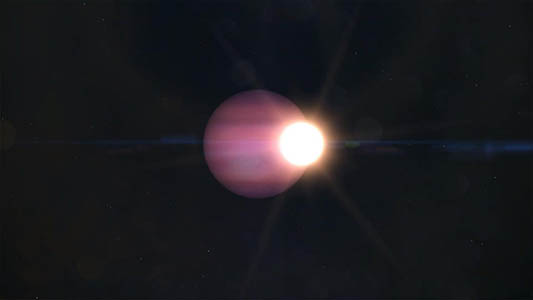
An international team of astronomers using NASA’s Transiting Exoplanet Survey Satellite (TESS) and retired Spitzer Space Telescope has reported what may be the first intact planet found closely orbiting a white dwarf, the dense leftover of a Sun-like star, only 40% larger than Earth. The Jupiter-size object, called WD 1856 b, is about seven times larger than the white dwarf, […]
René Doyon, Fellow of the Royal Society of Canada
The iREx is very pleased to announce that our Director, René Doyon, is now a Fellow of the Royal Society of Canada in the Academy of Sciences. The 2020 cohort of new members includes 87 individuals who were elected by their peers for their outstanding academic, scientific and artistic achievements. Two Université de Montréal professors, […]
BLACK HOLE FAILS TO DO ITS JOB
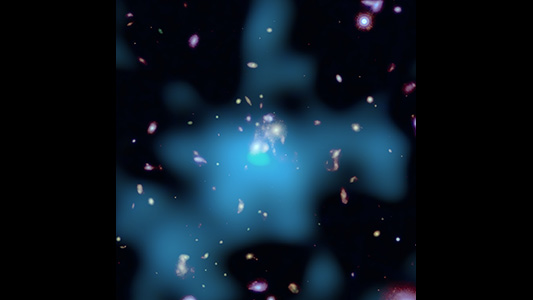
Astronomers have discovered what can happen when a giant black hole does not intervene in the life of a galaxy cluster. Using NASA’s Chandra X-ray Observatory and other telescopes they have shown that passive black hole behavior may explain a remarkable torrent of star formation occurring in a distant cluster of galaxies. Close-Up Composite Image, […]
Jonathan Gagné becomes the Rio Tinto Alcan Planetarium’s Scientific Advisor

Jonathan Gagné, a former Banting and Trottier postdoctoral researcher at the Institute for Research on Exoplanets at the Université de Montréal, became a Scientific Advisor at Space for Life in May 2020, where he leads a new fundamental research component at the Rio Tinto Alcan Planetarium. Jonathan, originally from the Laurentians, completed a Ph.D. at […]
A planet around the young star AU Microscopii
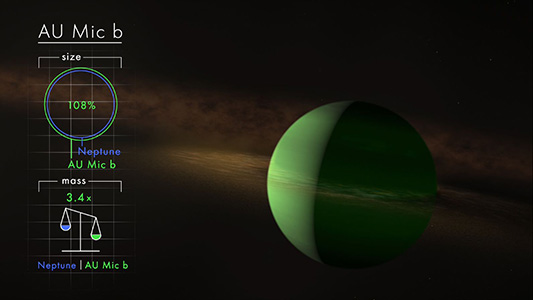
Jonathan Gagné, collaborator of the Center for Research in Astrophysics of Quebec (CRAQ), former iREx Banting postdoctoral researcher and now Science Advisor at Planétarium Rio Tinto Alcan, was involved in the discovery of a planet the size of Neptune around the young star AU Microscopii. Astrophysicists have been searching for planets in this system, which […]