$650,000 in research and infrastructure funds for the study of exoplanetes at Bishop’s University
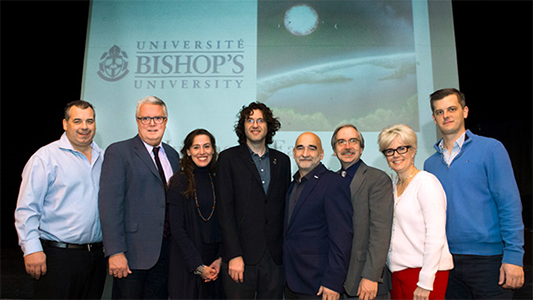
The possibility that our own galaxy contains Earth-like planets that may be able to support life has gone from science fiction to a very distinct possibility! Bishop’s University is proud to welcome Dr. Jason Rowe, a researcher who will play a key role in this type of discovery, to its Department of Physics and Astronomy. […]
Professor René Doyon receives the Urgel-Archambault Prize from Acfas
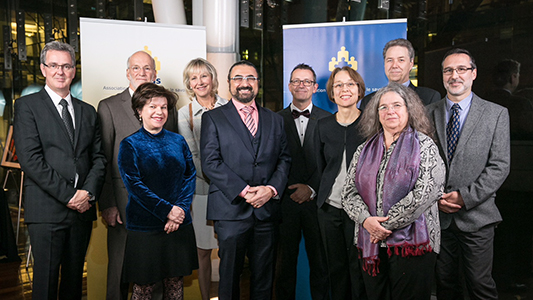
The Center for Research in Astrophysics of Quebec (CRAQ) congratulates René Doyon of the University of Montreal, member of the CRAQ and director of the Mont-Mégantic Observatory (OMM) and the Institute for Research on Exoplanets (iREx), who won the 2017 Urgel-Archambault Award, presented by the “Association francophone pour le savoir” (Acfas). René Doyon receives this […]
The nanosats of the BRITE space mission reveal the origins of fundamental structures in the wind of the supergiant star Zeta Puppis
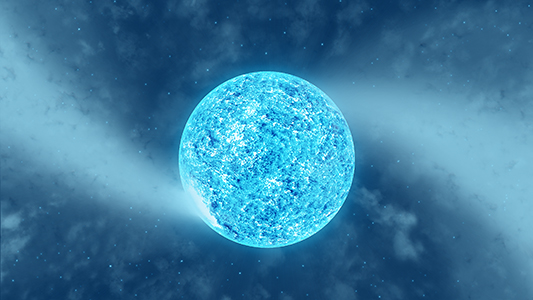
A Canadian-led international team of astronomers recently discovered for the first time observational evidence in how some features at the surface of the hot massive supergiant star Zeta Puppis induce the formation of fundamental structures in its wind. We are the children of stars. But it is more precise to say that we are the […]
The image entitled Flamboyant Galaxy wins the public award for the 2017 edition of the Acfas “La preuve par l’image” competition.
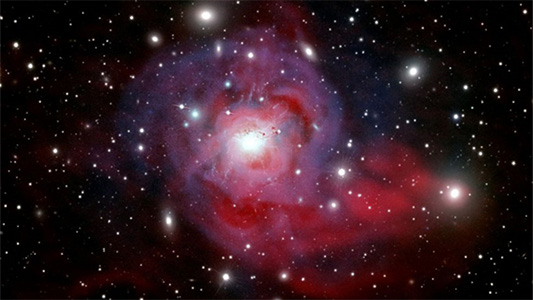
An unprecedented image of the Perseus galaxy cluster submitted by Julie Hlavacek-Larrondo and Marie-Lou Gendron-Marsolais, both researcher at the Université de Montréal and the Center for Research in Astrophysics of Quebec, and by the scientific communicator Maxime Pivin Lapointe, wins the public’s award in the 2017 edition of the Association francophone pour le savoir (Acfas) […]
Latest gravitational-wave detection opens new era for astronomy
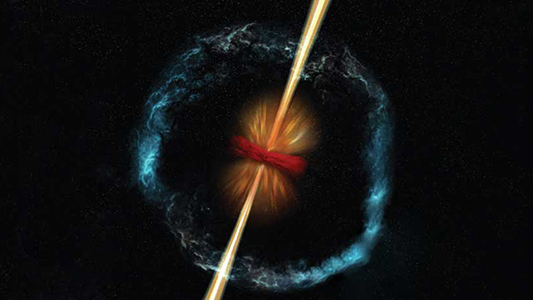
Neutron-star mergers could shed light on origin of universe’s heavy elements The discovery of a gravitational wave caused by the merger of two neutron stars, reported today by a collaboration of scientists from around the world, opens a new era in astronomy. It marks the first time that scientists have been able to observe a […]
Professor Daryl Haggard Receives Prestigious ICRA-Azrieli Fellowship

The Center for Research in Astrophysics of Quebec (CRAQ) congratulates Professor Daryl Haggard, of McGill University, for a prestigious scholarship offered jointly by the Canadian Institute for Advanced Research (CIFAR) and the Azrieli Foundation. Professor Haggard studies active galactic nuclei (accreting supermassive black holes) and their host galaxies. As a CIFAR Azrieli Global Scholar, she […]
NASA’s Hubble Captures Blistering Pitch-Black Planet
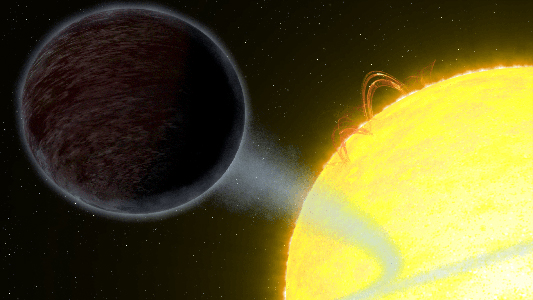
Alien world traps most of the visible light falling into its atmosphere NASA’s Hubble Space Telescope has observed a planet outside our solar system that looks as black as fresh asphalt because it eats light rather than reflecting it back into space. This light-eating prowess is due to the planet’s unique capability to trap at […]
New Canadian telescope will map largest volume of space ever surveyed
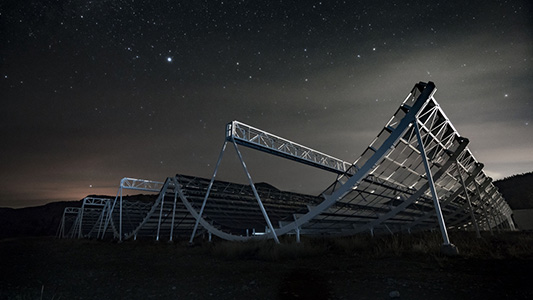
Radio telescope will help the world’s astronomers, physicists and scientists unravel today’s biggest cosmic mysteries A Canadian effort to build one of the most innovative radio telescopes in the world will open the universe to a new dimension of scientific study. The Honourable Kirsty Duncan, Minister of Science, today installed the final piece of this […]
Nearly 9,000 people watch the eclipse at McGill University!

The public observation activity of the Sun eclipse of 21 August, organized by McGill Astronomers, attracted an impressive crowd on campus. Read the detailed report here: McGill_eclipse_2017_report. The CRAQ thanks Kelly Lepo for the organization and success of this remarkable activity.
CRAQ astronomer, Anthony Moffat, help Recover Nova First Spotted 600 Years Ago by Korean Astrologers
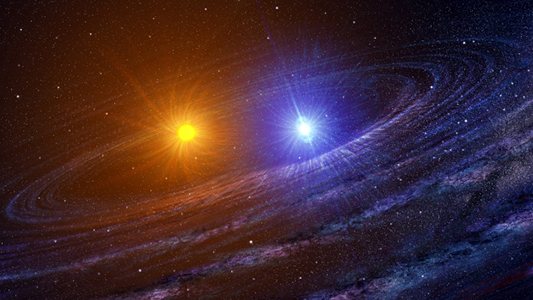
On a cold March night in Seoul almost 600 years ago, Korean astrologers spotted a bright new star in the tail of the constellation Scorpius. It was seen for just 14 days before fading from view. From these ancient records, modern astronomers determined that what the Royal Imperial Astrologers saw was a nova explosion, but […]