
Interview with Michaël Lévesque: Why do older stars rotate faster than expected?
The rotation of stars has long served as a cosmic clock. By measuring the rotation speed of a star similar to the Sun, astronomers could estimate its age with remarkable accuracy. But over the past decade or so, this method, known as gyrochronology, has shown signs of failing when applied to stars slightly older than the Sun. Why are they still spinning too fast, when they should have slowed down?
Michaël Lévesque is investigating this intriguing question. He is a PhD student, supervised by Paul Charbonneau at the University of Montreal, and a member of the Center for Research in Astrophysics of Quebec. He is also the lead author of the study Breaking gyrochronology through the collapse of coronal winds, conducted in collaboration with Paul Charbonneau.
Question: Could you explain to us in simple terms what gyrochronology is?
Gyrochronology is an empirical method that links a star’s rotational speed to its age.
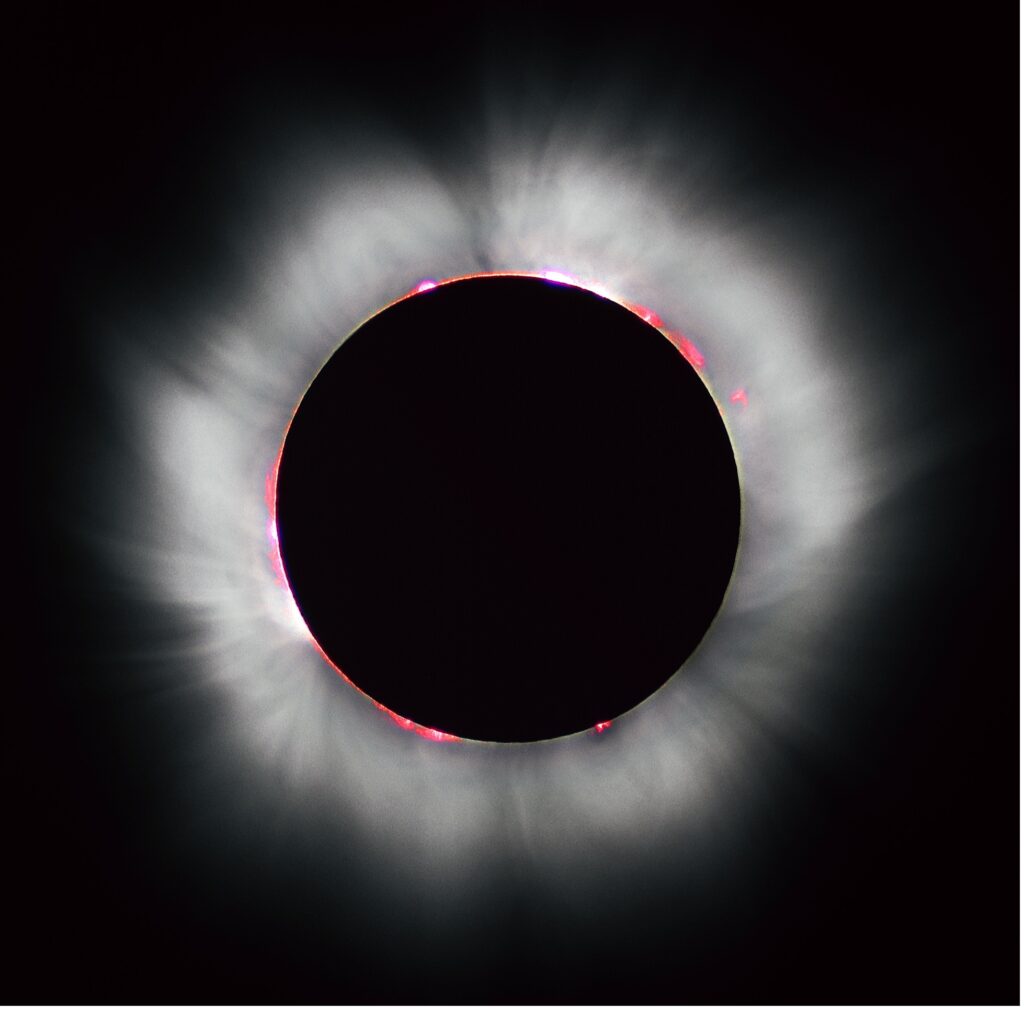
Like the Sun, stars have a stellar wind, consisting of a stream of charged particles escaping from the star’s corona. If you were lucky enough to see the total solar eclipse on 8 April 2024, you will no doubt have noticed, during the totality phase, the appearance of a white halo radiating from the Sun, much like hair radiates from a head. This structure is the Sun’s corona and forms the basis of the solar wind. Through various heating processes, this magnetised gas disperses into space. Stellar winds are the equivalent of solar winds for stars other than the Sun.
This wind is magnetised, meaning it can be deflected by magnetic fields. As stars have magnetic fields, they exert a force on their wind, which in turn exerts a force on the star, acting as a kind of brake. This is why stars rotate more slowly over time. In the case of the Sun, this mechanism is well understood and has been at work for billions of years.
Question: And yet, something isn’t quite right?
Indeed! Recent observations carried out by Jennifer van Saders’ team have shown that stars a few billion years older than the Sun rotate faster than gyrochronology would predict. This suggests that these stars have not been slowed down as effectively as expected.
Through these recent setbacks, classical gyrochronology has highlighted gaps in our understanding of the physics of magnetic braking in stars with masses similar to the Sun. It was therefore necessary to develop a new method of gyrochronology based on physical models, which would provide an additional method for determining the age of stars and lead to a better understanding of the evolution of stellar rotation.
Question: Your study explores a new hypothesis: that stellar winds collapse as stars age. Why is that?
In the context of changes in stellar rotation, reference is often made to an abrupt change in the dynamo regime, a mechanism by which stars generate their magnetic fields through their rotation. It is as if the star’s magnetic engine were to suddenly weaken. The problem is that this idea can only account for the observations by introducing artificial breaks in the models. Instead, we have explored another possibility: what if it were not the magnetic field that changed radically, but rather the wind itself that collapsed?
Our aim is to create a realistic model of rotational evolution that is based as much as possible on fundamental principles of physics rather than on mathematical relationships derived from observations. We have adapted a magnetised wind model formulated by Eugene Weber and Leverett Davis in 1967 for the Sun so that it can be applied to stars in general. This model remains fairly straightforward to simulate numerically. This approach has enabled us to test a different hypothesis to explain the observations made by Jennifer van Saders’ team: what if a change in the properties of the stellar wind were responsible for the decrease in the efficiency of magnetic braking?
Question: What happens in that case?
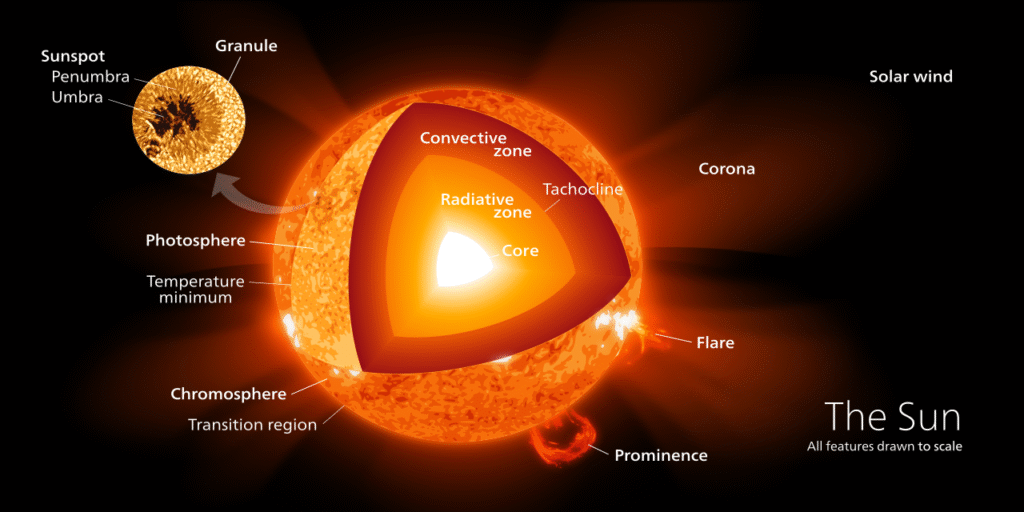
If the star’s corona receives less energy, it cools down. However, our models show that below a certain critical temperature, the wind becomes much less efficient. It then transports much less matter… and, above all, much less angular momentum. The result: the star practically stops slowing down. This implies that models of stellar rotation evolution can become tools for studying the processes that heat the corona, the mechanism of which is still unknown.
Question: You have shown that this explanation does not hold up entirely. What does that mean in practical terms?
In fact, we may have found one piece of the puzzle, but the heart of the problem remains. We have shown that it is possible to deviate from gyrochronology using our models, but not enough to explain the observations. The next step will be to investigate reduced efficiency in coronal heating in order to explain the observations. If this still fails to explain the observations, it means that a change in the dynamo regime must be part of the explanation.
Question: How does this change our understanding of the Sun and its future?
That’s a good question, and the answer depends on our future findings. If our research points towards a collapse of the solar wind, a weaker solar wind will lead to a reduction in the erosion of the atmospheres of planets in the Solar System, such as Earth. If, on the other hand, our future results point towards a change in the dynamo regime, this implies that the Sun’s magnetic activity will decrease significantly over the next few hundred million years, which could potentially lead to a reduction in solar flares.